
A generous law
Torah and grace...

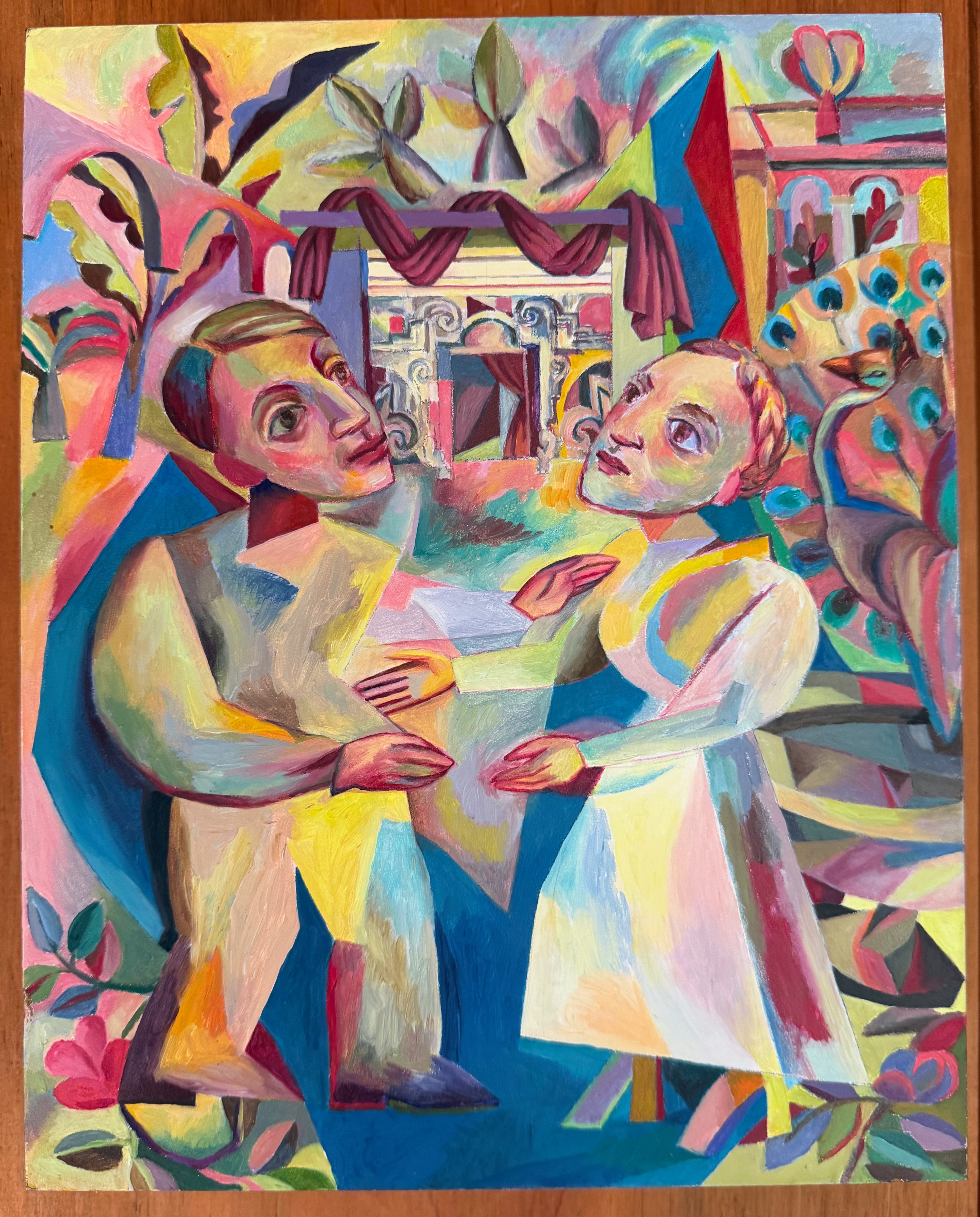
Mystic Marriage, ©Tanja Butler, 2008. Oil on board, 10” x 8”. Collection of Meg and Bruce Herman.
The Apostle Paul was a fierce opponent of legalism (strict adherence to religious custom as a means of saving ourselves or establishing our own holiness). If you’re not a Jew or a Christian, this might seem a bit of a tempest in a teapot. “Who cares about antiquated religious practices. We’re modern people and we don’t need all that.” James Joyce spoke, in Portrait of the Artist as a Young Man as though religion and history and tradition were a “nightmare” from which we need to awaken. And a prevailing wind of modernity has been just that—the notion that we can re-invent ourselves sans religion and all the baggage of tradition. But as Hans George Gadamer points out in his seminal essay “The Relevance of the Beautiful” we only fool ourselves if we think we can be free of tradition. Our very language and the structure of our thinking is saturated with it—its the air we breathe. Moreover, our very capacity for meaning-making and our receptivity to the Beautiful are contingent upon tradition. Tradition is a living thing that is more transmitted than preserved, more translated to the next generations than something caught in amber to be conserved and protected.
…but more about tradition and the relevance of the Beautiful in a moment.
+++++++
Saint Paul’s fierce fighting against religious legalism is not a rejection of tradition, but rather a deeper form of respect for it. In the New Testament book of Galatians (his letter written to the Christ-followers at Galatia) he is at pains to make this central point: the Law (Torah) exists to point us toward spiritual freedom, not mental slavery to custom. He demonstrates how to read the Law in a wonderful passage in chapter four, in which he uses the story of Abraham to make his point—declaring that the two sons (Ishmael and Isaac) and the two wives (Hagar and Sarah) are two traditions, two “mountains”, two covenants, two spiritual systems. He says this story is an allegory in which one of the sons is earthbound and exemplifies our misguided dependency upon our own efforts to achieve self-salvation and the other is a child of promise, a free-gift of grace. And grace is an incomprehensible freedom in which we acknowledge from the outset that all our self-generated notions of God are hopelessly flawed and we need God to intervene—with God’s ultimate generosity—to set us on the path to genuine spiritual freedom.
The Apostle is essentially saying that the Torah exists to point beyond itself to God—to God’s love and acceptance and forgiveness. The Law doesn’t exist for its own sake. It’s a tutor, a babysitter, an au pair that is only relevant until that ultimate freedom is had and the child grows up. But the key concept in Paul’s thinking is that it is impossible to achieve this spiritual freedom on our own because we are hopelessly mired in self-centeredness and the sad fact that we are able be “good” for bad reasons: self-righteousness. The true liberation only comes from God’s intervention on our behalf. The Law is a generous law with a deeper sense of meaning than simple adherence to rules. It’s not about rules. It’s about love, about relationship. The Torah points toward Christ—who is the embodiment of God’s love and forgiveness and hospitality.
+++++++
About Beauty and our capacity to recognize it and celebrate it: in his essay, Gadamer makes the claim that Beauty can only really be encountered communally. We cannot enter into it as a solo flight. It requires preparation in something as significant as civilization—what might be called the festival of tradition. Not a choking, restrictive sense of “should and ought” but the welcome, the hospitality of heart that says, “Look at this! Come to the feast of beauty!” Why this is relevant is that in order for us to become spiritually mature we must see—we must hear the Truth. And the Truth is that God is beauty, God is life and light. God is love.
If you think of yourself as an atheist, it may be because you’ve outgrown a childish vision of God as a bearded man on a throne dictating moral predicates. If that’s the case, you’re on your way to what Saint Paul is pointing toward. The heart of the Torah, the heart of Christ is not adherence to dry religious doctrines but it is the welcome to freedom, the celebration of the Beautiful. It’s an invitation to the Dance:
At the still point of the turning world. Neither flesh nor fleshless;
Neither from nor towards; at the still point, there the dance is,
But neither arrest nor movement. And do not call it fixity,
Where past and future are gathered. Neither movement from nor towards,
Neither ascent nor decline. Except for the point, the still point,
There would be no dance, and there is only the dance.
Here, in “Burnt Norton”, first of the four poems comprising T. S. Eliot’s Four Quartets, the poet is articulating his deepest grasp of this heart-principle of divine love. It is not a contest between the body and the mind—not a fight between material and spiritual—but rather it is the invitation to a cosmic dance in which the human and the divine are in communion. It’s not about human effort. It is not about self-perfection. It is about friendship, forgiveness, and freedom. The Law is a generous law pointing beyond itself to the Lawgiver who loves us and wants us freed from slavery of every sort—especially from the slavish adherence to rules that offer no real life but only a form of living death. Religion as restriction.
If you find yourself a bit lost in this discussion, and if there’s nothing else to take away from my brief meditation here, remember this: at the heart of the biblical tradition is relationship—a relationship of welcome and freedom, not a set of rules to “bind with briars my joys and desires” as William Blake put it. It is not about mental or emotional or spiritual slavery but about friendship with God, with the Source of the Beautiful. And even that last sentence is full of awkward mystery. How can we be friends with the One who created the vastness of the cosmos? I will leave it here: the One who wills the existence of conscious beings, eternal beings, is the same One who intends to spend eternity in freedom and welcome and communion with us.
This is the heart of the biblical tradition: invitation to the Dance.
+++++++
Note about the image above: the artist Tanja Butler is a dear friend living in Upstate New York—an emigré from Germany in early childhood, she has spent most of her life in Albany where she currently resides. We taught together for over a decade at Gordon College before she retired early to return to Albany with her husband Tony. Her paintings are childlike and yet very sophisticated at the same time. This little jewel of a painting, Mystic Marriage, is in our collection and the artist gave us permission to use it for the cover of the order of service for the renewal of our wedding vows after forty years of marriage. That was thirteen years ago. It is a picture of the ultimate wedding—of the human and the divine—in the mystic Dance of communion.
“The One who wills the existence of conscious beings, eternal beings, is the same One who intends to spend eternity in freedom and welcome and communion with us.” May I diddle with this doozy? The One who wills the existence of conscious beings, eternal beings, is the same One who intends for us to spend eternity in the freedom, welcome, and communion of the One, as little friends of the One.
And regarding that function of the law of which you wrote, I was not won over by seeing, in and through the cross, all my sins forgiven. Rather, I was won over through being encountered by the prodigal love and tender care of the gloriously condescending Creator, as per the father depicted in the narrative prose poem of Jesus that’s commonly called the parable of the prodigal son. As for what to make of what God was doing in the grisly event of Jesus' death? That, for me, has come much later.
I love the ideas expressed here, especially the idea that the Maker of the Glorious Cosmos wants to be Friends with what it has made.