
Dancing Dust
old age and youth in the mix

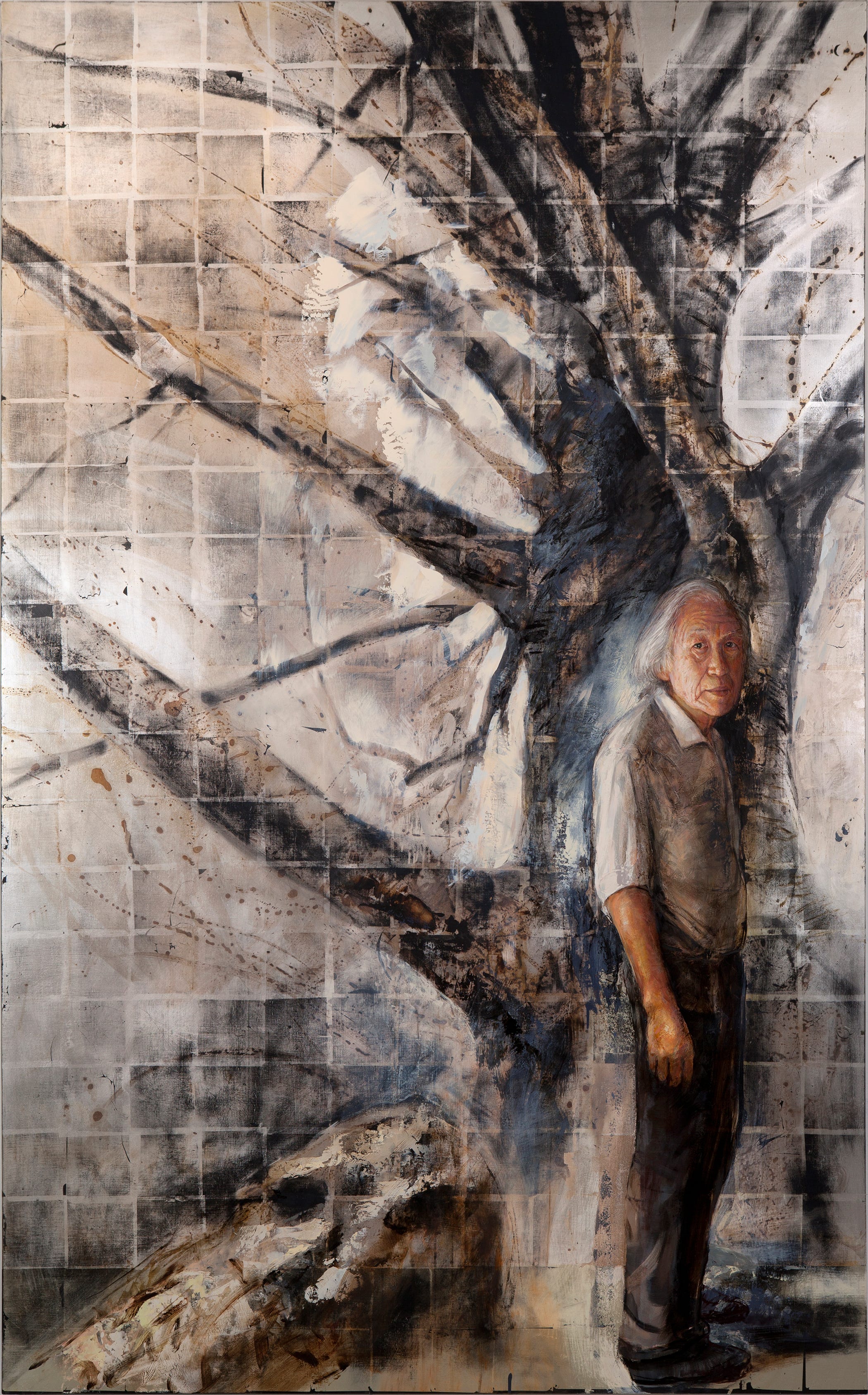
Image: QU4RTETS No.4 (Winter–portrait of Osamu Fujimura) ©Bruce Herman, 2012
Your wishes will be fulfilled, you will gape then
At the essence of time, woven of smoke and mist,
An iridescent fabric of lives that last one day,
Which rises and falls like an unchanging sea.
Books you have read will be of use no more.
You searched for an answer but lived without answer.
cf. “YOUTH” by Czeslaw Milosz
I often find myself, these days, reflecting and writing (and probably painting) about aging. It’s not a conscious decision or some agenda. I am just here–living in this “country for old men”. Of which W. B. Yeats said,
That is no country for old men. The young
In one another’s arms, birds in the trees,
—Those dying generations—at their song,
The salmon-falls, the mackerel-crowded seas,
Fish, flesh, or fowl, commend all summer long
Whatever is begotten, born, and dies.
Caught in that sensual music all neglect
Monuments of unageing intellect.
cf. “Sailing to Byzantium” by William Butler Yeats
But I live in this country! I know its capitol: the heart. After decades of striving, one comes at last to a kind of active rest (if you’re paying attention) in which you have completely intuitive priorities––you live from the core of who you are, from your heart, your center. All the periphery begins to fade and falter--even disintegrate. In this country of old men (and women of course) the fancies of youth pale and seem, well, woven of smoke and dust (as Milosz so wonderfully puts it above).
Does that mean that I am a chauvinist for old age? Not really. But I am certain of very few things--and one of them is that there are qualities, certain insights reserved for old age. (Because of the inescapability of one’s own mortality as it proceeds from ailment to ailment, from one loss to another.) One of those exclusive insights may be shared--at least in written or artistic form: a meditation on mortality itself. On death.
Not something that the young want to think about.
But this mediation on death can be shared only in theory (unless you’re already in hospice--but in that case you’re unlikely to be writing or painting or dancing or singing very much). I say “shared in theory” because one really cannot share one’s own grasp of mortality in any meaningful way. The loss is just that. Loss. But what I want to share in this brief meditation is this--that remembering we are dust and unto dust we shall return–this can be practiced from your youth to maturity to old age.
And that memento mori (remember death) is a watchword for those swept up in their self-importance. You too will be forgotten eventually, even if you make it into the history books. Because those books will burn up like everything else that is predicated on the basic falsehood that we invent ourselves. The truth is that we receive ourselves, our name. (As I wrote in my last post here on Substack Naming and Taming.) And that receiving of a name means we are children being given scope for play.
A bit cryptic? Well, maybe this needs to stay slightly opaque. But here–as a last shot in this little reflection: the centrality of play, of unguarded exploration and creative risk taking–this play is what the kingdom of God is all about. And that is, I believe, what Jesus was talking about with Nicodemus in that famous passage in John 3. He told the aging Pharisee that all his learning and effort at being holy needed to be surrendered–“You must become like a little child…You must be born again… those born of the Spirit are like the wind…” All these things Jesus told the old man were about letting go of power, influence, reputation, learning…anything that stands between us and the childlike wonder of divine love.
As we enter Lent it’s a good thing to remember that we are dust—but we are dancing dust, colorful dust–and we’re invited to be reborn as children of the One who plays eternally.