
On a precipice
…technology, objectification, and caritas

Much “ink” is spilt these days about AI and its benefits and threats. I’ve posted here before that I think the real threat and benefit with this new tech is the same threat and benefit as we’ve always had with any of our tools. It’s the human agent who wields the tool (weapon?) that is the source of either good or ill.
But I do think it’s worth noting that certain technological breakthroughs have changed us—changed our capacity to know and to care. The latter is of greater concern to me. Objectification of our world and each other is always the greatest threat—and a form of social dysfunction resulting from a utilitarian, individualistic focus. A technology that assists in objectification must be regulated differently—just as the invention of the wheel and the discovery of atomic fission are orders of magnitude different in their ethical ramifications and requirements.
So here’s my little thought for today on AI: it will never be conscious and it will never have a conscience. It is a tool. Period. That said, it will outstrip us in cognitive function (and may have already done so). What it can never do is care about us, care about our environments, our traditions, our morality, our loves. It will never develop authentic empathy—only mimic it like a magic mirror. The word “intelligence” is actually a misnomer. More accurate and to the point is the former tag “machine learning”.
+++++++
Caring is a way of being that is contingent upon consciousness—specifically consciousness of persons and beings—awareness and curiosity about/care for others. About our world. About the beasts and birds and fish and crawling things—about plants and everything living. Do we care? Or is everything our object to use and possess? My conviction is that we will destroy ourselves quickly if we fail to see this one needed thing: caring / caring-for (caritas) is the central aspect our soul, our humanity. Without caritas we are less than human. Less than animal. Animals care for their own and nurture them. Even insects and lower life-forms do the same, routinely sacrificing for one another, for the common good. When an animal hoards, it is always a sign of dysfunction1. Caring and sharing are twin forms of conscious outreach to others.
Intelligence is not enough.
The Cartesian “I think therefore I am” is a mistake. I care, I connect with another, therefore IAM. A person is fundamentally irreducible, and to attempt to objectify a person is the greatest form of violence. Objectification of any living being is violent and is the real cliff upon which we stand. We stand or fall (over the precipice) on this reality—that a person cannot be manufactured or reduced to a thing, a tool. That’s the central offense of slavery—the delusion of conscious AI.
I pray we never learn to use AI to enslave. I fear we may have already begun this baleful thing—to systematize the objectification of people for machine-goals like efficiency and productivity.
We can be better than this.
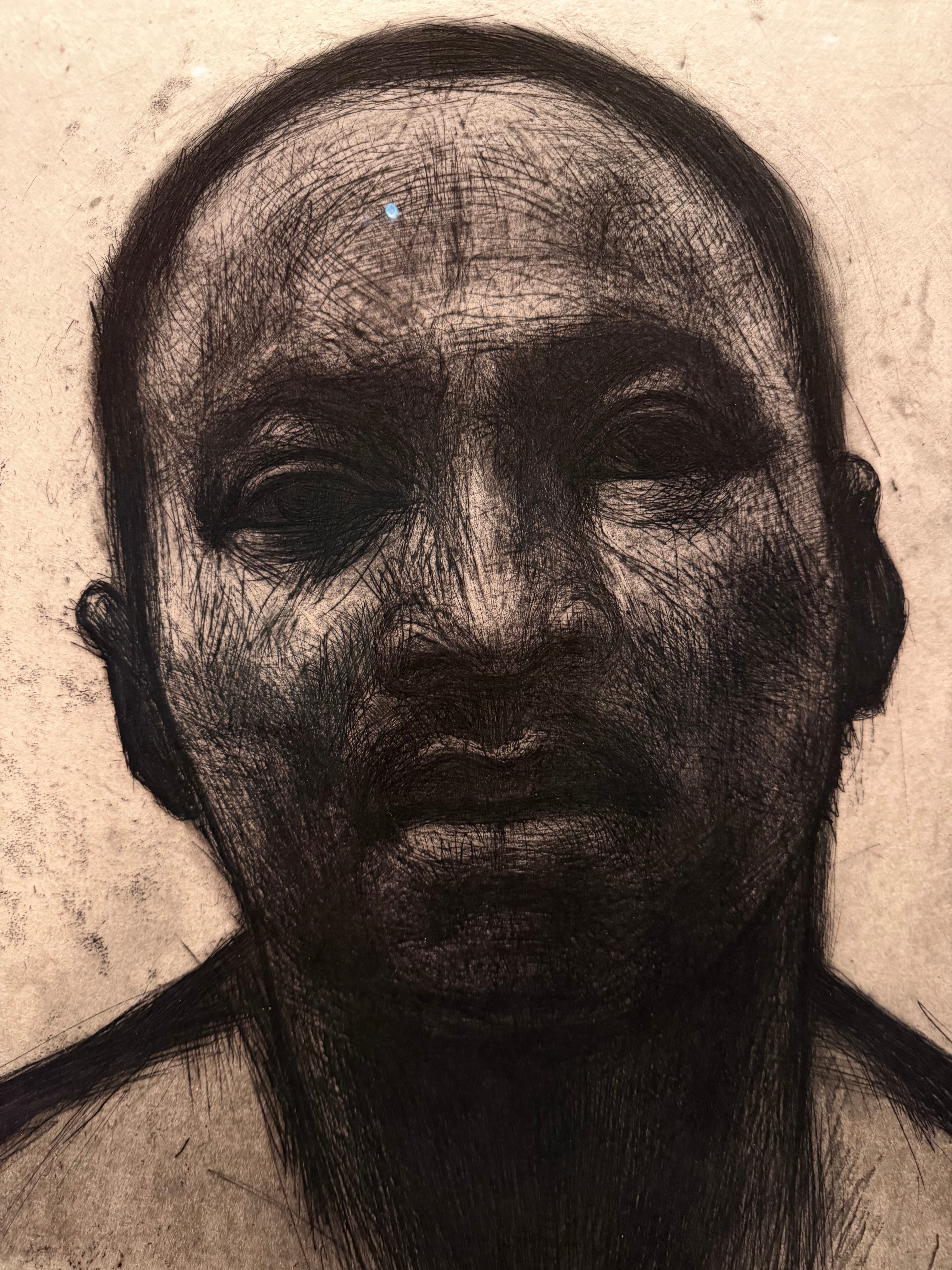
Image: detail of John Wilson’s powerful and moving etching portrait of Dr. Martin Luther King. .
Experiments have been performed (sadly) on primates in which the action-to-fulfill-need mechanism in the animal is twisted and manipulated into a hoarding impulse and the animals lose weight, stockpile food (failing to even eat what they need) and begin a kind of auto-destruct mode. The fact that animals are “used” at all is a tragic aspect of our wounded and broken condition, but these experiments point toward this foundational reality: all living beings need to live in community, in mutuality of some kind.
Just this week, my friend asked me to edit her resume for several jobs to which she is applying. She said they feed the resume through AI and it has to tic off all the right boxes before you can get to a human.
The other day, my husband waited through 15 minutes of AI sub-categories for a medical appointment to finally reach a human. Sadly, that person’s response was that the next available appointment was tomorrow or January 8. They wouldn’t give him the tomorrow appointment because he was testing positive for Covid. She never offered a telemedicine option.
I drove over to the doctor’s office in an attempt to snag that next say appointment. I described the situation. They actually asked me if we were established patients of this doc. I said, “Yes. Why do you think I know where your office is?” And, let’s get this sorted out.
Two additional people later…first, the admin, then the nurse, then the doc…to a yes, of course, we’ll do a telehealth appointment.
I asked the admin if she could book it. No. That’s a different set of actions. BUT she instructed me how to tell my husband how to do it online which I texted him from their office. You see, I wasn’t leaving until he had an appointment.
He did what she suggested. It was like…you mean, he could have done this in the first place? Suddenly, she said, “Oh! There he is! He’s in the schedule.” The complexity of actions to make one simple thing happen boggles the mind.
I think there are many fears about AI. But the biggest one is the use of water. If they use desalination, I’ll feel better.
And yeah… it is a tool. But what is the cost?
It's becoming clear that with all the brain and consciousness theories out there, the proof will be in the pudding. By this I mean, can any particular theory be used to create a human adult level conscious machine. My bet is on the late Gerald Edelman's Extended Theory of Neuronal Group Selection. The lead group in robotics based on this theory is the Neurorobotics Lab at UC at Irvine. Dr. Edelman distinguished between primary consciousness, which came first in evolution, and that humans share with other conscious animals, and higher-order consciousness, which came to only humans with the acquisition of sophisticated language (especially math and logic). A machine with only primary consciousness will probably have to come first.
What I find special about the TNGS is the Darwin series of automata created at the Neurosciences Institute by Dr. Edelman and his colleagues in the 1990's and 2000's. These machines perform in the real world, not in a restricted simulated world, and display convincing physical behavior indicative of higher psychological functions necessary for consciousness, such as perceptual categorization, memory, and learning. They are based on realistic models of the parts of the biological brain that the theory claims subserve these functions. The extended TNGS allows for the emergence of consciousness based only on further evolutionary development of the brain areas responsible for these functions, in a parsimonious way. No other research I've encountered is anywhere near as convincing.
I post because on almost every video and article about the brain and consciousness that I encounter, the attitude seems to be that we still know next to nothing about how the brain and consciousness work; that there's lots of data but no unifying theory. I believe the extended TNGS is that theory. My motivation is to keep that theory in front of the public. And obviously, I consider it the route to a truly conscious machine, primary and higher-order.
My advice to people who want to create a conscious machine is to seriously ground themselves in the extended TNGS and the Darwin automata first, and proceed from there, by applying to Jeff Krichmar's lab at UC Irvine, possibly. Dr. Edelman's roadmap to a conscious machine is at https://arxiv.org/abs/2105.10461, and here is a video of Jeff Krichmar talking about some of the Darwin automata, https://www.youtube.com/watch?v=J7Uh9phc1Ow